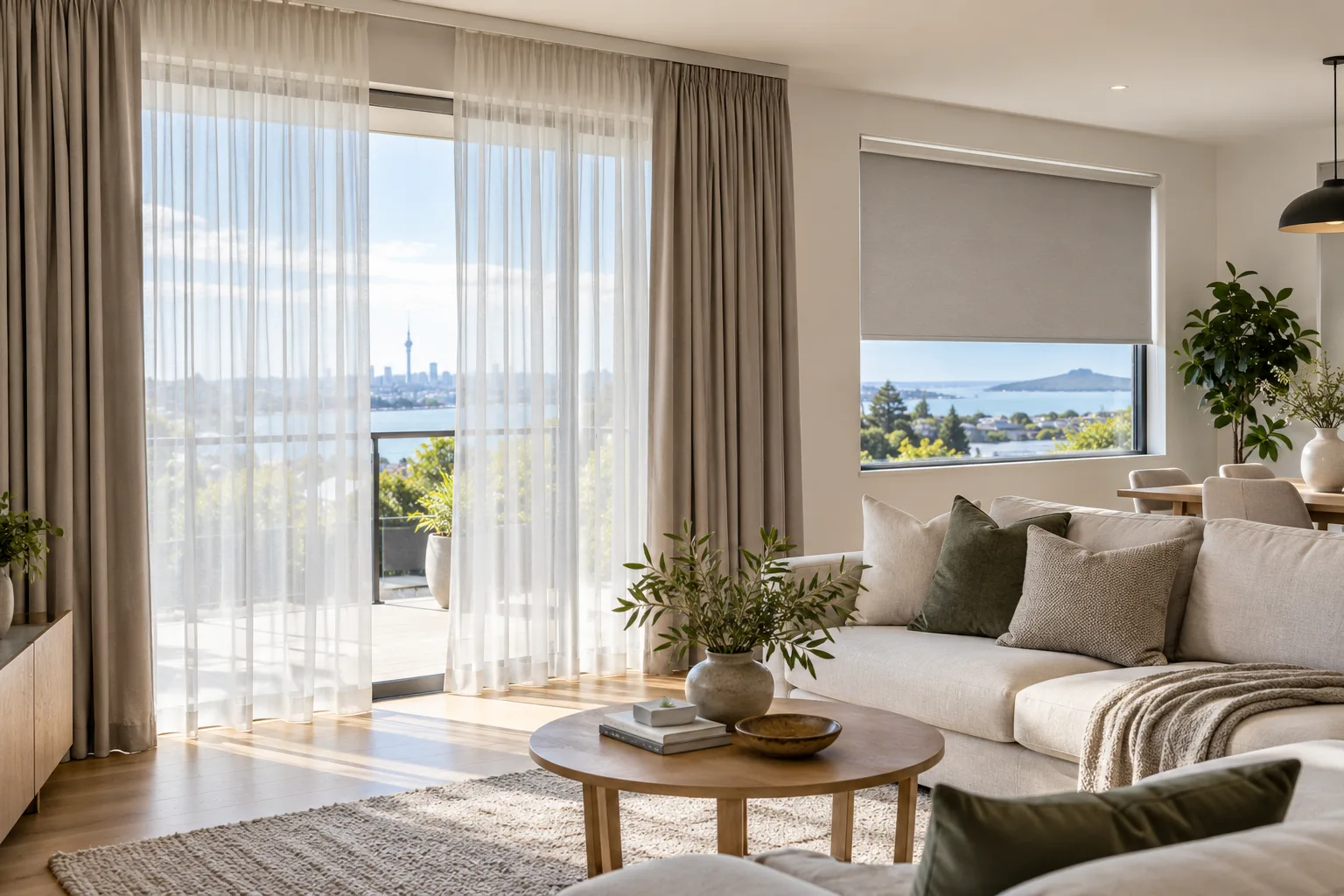
Picture a winter evening in Auckland. The sun drops behind the hills, and before the lounge starts to cool, your curtains close on their own. In the morning, the bedroom blinds lift a few minutes after sunrise. Nobody touched a cord or a button.
That’s what connecting curtains and blinds to Alexa or Google Home makes possible. This guide covers how smart window furnishings work, how to plan them around the way the sun moves through a New Zealand home, what to ask for when you order, and how to set up the commands and routines that make the biggest difference.
The short answer: You need a motorised blind or curtain track, a way to connect it (a hub, built-in Wi-Fi or Matter), and the Alexa or Google Home app. Link the motor’s app to Alexa or Google, assign each blind to a room, and you can control it by voice, on a schedule, or from your phone anywhere. The easiest way to get there is to order curtains and blinds that are made ready for a motor.
How Smart Curtains and Blinds Work
Every automated window has three parts: a motor that moves the blind or curtain, a connection that lets the motor talk to your network, and a voice assistant or app that sends the commands. The motor sits inside a roller blind’s tube, in a Roman blind’s headrail, or in a curtain track. The connection is where systems differ most.
| Connection type | How it works | Good to know |
| Hub or bridge | A small plug-in device translates the motor’s radio signal for your Wi-Fi, Alexa and Google | The most common setup. One hub can run many blinds, and it keeps them off your main Wi-Fi. |
| Built-in Wi-Fi | The motor joins your Wi-Fi network directly | No hub needed, but each motor uses your Wi-Fi. Many only connect on 2.4 GHz. |
| Matter | A shared smart home standard that works across Alexa, Google Home, Apple Home and SmartThings | Window coverings have been part of Matter since version 1.0. Useful if you might change systems later. |
Plan Your Automation Room by Room
Before you choose a motor or a voice assistant, work out what each room needs. In New Zealand, the direction a window faces shapes almost everything:
- North-facing rooms get the most sun through the day. Automation helps you let warmth in during winter and soften glare in summer.
- West-facing rooms take the strongest afternoon sun. A routine that lowers sunscreen blinds mid-afternoon protects floors and furniture and keeps the room cooler.
- East-facing bedrooms light up early. Blockout blinds that open on a schedule, rather than at first light, protect sleep.
- South-facing rooms get little direct sun and lose heat fastest. Closing thermal curtains early in the evening matters most here.
| Room | What to automate | Treatment that suits |
| Bedroom | Wake-up opening, privacy at night | Roller blinds in blockout, with a sheer curtain in front |
| Lounge | Close at sunset, movie-night scene | Curtains on a motorised track, or a blockout roller |
| Kitchen and dining | Glare control at set times | Roller or Roman blinds |
| Sliding doors and tall windows | Open and close wide spans in one movement | Curtains on a motorised track |
| Home office | Screen glare through the afternoon | Sunscreen roller blinds |
You don’t have to automate every window. Many homes start with the hardest-to-reach windows and the rooms where routines save the most effort, then add more later.
Choose Curtains and Blinds That Are Ready to Motorise
A motor only performs as well as the blind it drives. A roller tube that is too small for the fabric, a headrail without room for a motor, or a curtain track not designed to be motorised will cause trouble. Planning for a motor when you order means you can automate straight away, or add the motor later without replacing the blind.
When you book a measure and quote, ask:
- Can the blind be made with a tube or headrail that suits a motor?
- Is the curtain track designed to take a motor, and can it carry the weight of the fabric?
- Is there enough depth in the window recess for the motor?
- Where will power come from, and is there a socket nearby for a hub?
Battery or hardwired?
Rechargeable battery motors need no wiring, which makes them the simplest choice for existing homes. Most are recharged with a cable every few months, depending on use. Hardwired 230V motors never need charging but need power at the window, and in New Zealand they must be connected by a licensed electrician. If you’re building or renovating, ask your electrician to run cabling to the windows before the linings go on.
How to Connect Your Blinds to Alexa or Google Home
Once the motors are fitted, setup takes three steps.
- Pair the blinds in the motor brand’s app. Install the app, add the hub if you have one, and pair each blind. Set the fully open and fully closed positions, then test each one.
- Link the app to your voice assistant. In the Alexa app, tap More, search for your motor brand’s skill, tap Enable to Use and sign in. In the Google Home app, tap Add, then Link app or service, then Works with Google, search for your motor brand, select it and sign in.
- Put every blind in a room. Assign each blind and curtain to a room such as “Bedroom” or “Lounge”. This lets one command control a whole room.
Voice Commands That Work Every Time
Voice assistants respond to the names you give your blinds, so naming matters more than most people expect.
- Keep names short and different. “Lounge blind” and “Lounge curtain” are easy to tell apart. “Blind 1” and “Blind 2” are not.
- Use positions. “Hey Google, open the office blind to 50%.” “Alexa, set the lounge blinds to 30%.”
- Use rooms and groups. “Alexa, close the bedroom blinds.” Create a group such as “Downstairs” in the app, and “Alexa, close downstairs” moves every blind in it.
Test a few position commands before you rely on them. Some apps read 30% as 30% open and others as 30% closed.
Routines Worth Setting Up in a New Zealand Home
Routines turn smart blinds into blinds you never think about. In Google Home, set them up under Automations. In Alexa, tap + and choose Routine. Sunrise and sunset triggers follow your location, so they adjust through the year, including when the clocks change in September and April.
- Close at sunset in winter. Energy efficiency advice from EECA is to close curtains as soon as the sun goes down to hold in the day’s warmth. A sunset routine does this every evening, even when you’re out. Thermal curtains and blockout linings help most.
- Shade west-facing rooms in summer. Lower sunscreen blinds from early afternoon until the sun moves off the glass.
- Wake up gently. Open bedroom blinds partway at 6:45 am on weekdays, then fully 15 minutes later.
- Look lived-in while you’re away. Open and close street-facing blinds at normal times when you’re on holiday.
- Movie night. One command lowers the lounge blinds and dims your smart lights.
Our guide to blinds vs curtains for energy efficiency explains which treatments keep the most heat in.
Alexa, Google Home or Apple Home?
All three control blinds well, and most major motor brands support Alexa and Google Home. The best choice is usually the system already in your home: Google Home if you have Nest speakers, Alexa if you have Echo devices. If you use an iPhone and want Apple Home, check that the motor or hub supports HomeKit or Matter before you buy.
Troubleshooting Common Problems
| Problem | Likely cause | What to do |
| Alexa or Google can’t find the blinds | Account not linked, or hub on the wrong Wi-Fi band | Relink the skill or app, check the hub is on 2.4 GHz if required, then ask the assistant to discover devices |
| A blind ignores some commands | Similar names, or the blind is out of the hub’s range | Rename to something distinct, and move the hub to a central spot away from metal and thick walls |
| Routine runs at the wrong time | Wrong location or time zone in the app | Check the home address and time zone in both the motor app and your assistant |
| Nothing works in a power cut | Wi-Fi and hub are off | Battery motors still run from their handheld remote. Voice control returns when the power does |
Frequently Asked Question
Can I automate my existing blinds?
Sometimes. Roller blinds can often take a retrofit motor if the tube and brackets suit it. Curtains usually need a new motorised track. If your blinds are old, worn or the wrong size, replacing them with motor-ready blinds is often the better long-term option.
Do smart blinds work without the internet?
Yes, through the motor’s remote or wall switch. Voice control and app control from outside the home need your Wi-Fi and internet connection.
Are motorised blinds safer for children?
Motorised blinds have no hanging cords or chains, which removes a known strangulation risk for young children and pets.
Do I need an electrician?
Not for battery motors. Hardwired 230V motors must be connected by a licensed electrician.
Start with Curtains and Blinds Made for Your Windows
Smart control works best when the curtains and blinds behind it fit perfectly. At Gorgeous Curtains, we make made-to-measure blinds and curtains in fabrics from Warwick, James Dunlop and Charles Parsons. Let us know at your consultation that you plan to automate, and we’ll make your blinds and tracks ready for a motor, so your installer or electrician can fit it now or later.
We bring fabric samples to your home anywhere across Auckland and measure every window for a precise fit. Book a free consultation, call 09 218 2288, or visit our showroom at Unit 4/19 Apollo Drive, Rosedale.